
Connect With Us
The Current

Our Insights

July 5, 2026

Meta Enters the Cloud Wars

**Meta Enters the Cloud Wars **

STORY OF THE WEEK

Meta Enters the Cloud Wars

The last hyperscaler without a cloud business is finally joining a market worth more than $500 billion.

Meta Enters the Cloud Wars

**Meta Enters the Cloud Wars **

Meta (META) surged roughly 9% this week after reports emerged that the company is preparing to launch its own cloud computing platform, marking its most significant business expansion since entering artificial intelligence. While Amazon (AMZN), Microsoft (MSFT), and Alphabet (GOOGL) have long leveraged cloud infrastructure into highly profitable businesses, Meta has remained the lone hyperscaler without a commercial cloud offering, until now.

The move could fundamentally alter how investors evaluate Meta's AI spending, which critics have long questioned for generating little return outside advertising; a cloud platform would let Meta monetize its chips, data centers, and AI infrastructure directly, creating a potential second profit engine alongside advertising. Early reports suggest it plans to offer both bare-metal computing and hosted AI models, putting it in direct competition with providers from Amazon Web Services to newer players like CoreWeave (CRWV) and Nebius (NBIS) prompting several cloud infrastructure stocks to fall sharply as investors weighed the arrival of a well-funded new entrant.

  • Meta added roughly $150 billion in market value after reports surfaced that the company is developing a cloud computing business.

  • The company is expected to offer AI compute capacity and host large language models, leveraging infrastructure it already built for its own AI initiatives.

  • Core Weave lost an estimated $7 billion in market value and Nebius shed roughly $11 billion as investors reassessed the competitive landscape.

Cloud computing has quietly become one of the most profitable businesses in technology, with AI accelerating demand for computing power across virtually every industry. Meta's entry validates the strength of that market, but it also raises new questions about competition, pricing, and whether the current AI infrastructure boom is approaching its next phase.


CLIMBS OF THE WEEK

What's Up in the Markets

What's Up in the Markets

RDDT (+16.6%): Shares climbed after investors renewed optimism around the platform's growing advertising business and expanding role in AI training data partnerships.

PLTR (+14.5%): Continued enterprise AI adoption and government contract momentum helped push shares higher as investors remain enthusiastic about demand for the company's software platform.

META (+5.9%): Investors cheered reports that Meta plans to launch its own cloud computing platform, potentially creating a lucrative new revenue stream beyond digital advertising.

SLIDES OF THE WEEK

What's Down in the Markets

What's Down in the Markets

SSTK (-31.0%): Shares moved lower as concerns continue to build around AI-generated content disrupting traditional stock image businesses.

CRWV (-15.4%): The AI cloud provider sold off sharply as traders reassessed growth expectations amid the prospect of Meta entering the sector.

NBIS (-10.3%): Investors reacted negatively to reports that Meta's cloud ambitions could create another major competitor in the AI infrastructure market.

CHART OF THE WEEK

America's Hiring Engine Is Slowing Down

America's Hiring Engine Is Slowing Down

America's Hiring Engine Is Slowing Down

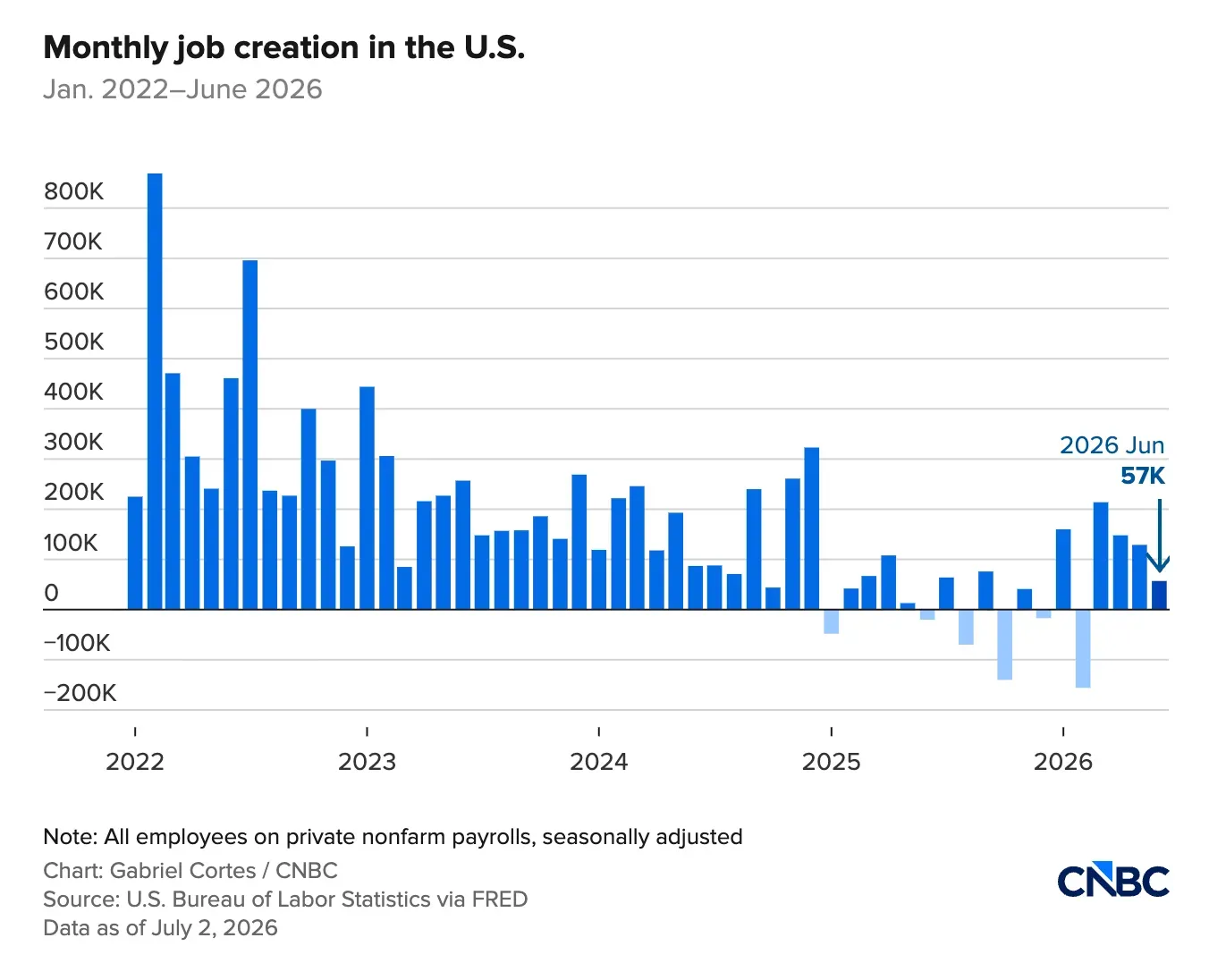
Private payroll growth is losing momentum. U.S. employers added just 57,000 jobs in June, marking one of the weakest monthly hiring totals since the post-pandemic recovery began. The chart shows a clear downshift from the extraordinary labor demand of 2022, when monthly job creation frequently exceeded 300,000 and occasionally surged above 800,000. Since then, hiring has steadily moderated as higher interest rates, slower economic growth, and corporate cost controls have weighed on labor demand.

The slowdown matters because employment remains the foundation of consumer spending and broader economic activity. While payroll growth remains positive, the trend is moving in the wrong direction, with several months in 2025 and 2026 producing little or no net private-sector job creation. As hiring becomes more selective, wage growth and consumer spending could face additional pressure. The key question for investors and policymakers is whether the labor market is approaching a soft landing or entering a more pronounced slowdown heading into the second half of 2026.

The Current