Connect With Us
The Current

Our Insights

November 8, 2026

STORY OF THE WEEK

What the Midterms Mean for Markets

Investors spent the week adjusting to a new Congress, and different parts of the market reacted in different ways.
What the Midterms Mean for Markets

Democrats won control of both the House and the Senate in Tuesday’s midterm elections. In Texas, James Talarico defeated Ken Paxton to become the state’s first Democrat elected to the Senate since 1988, and Gina Hinojosa defeated Gov. Greg Abbott, becoming the first Democrat elected governor there since 1990. Exit polls showed the economy as voters’ top issue, and most said inflation had caused hardship. Most also said the U.S. made the wrong decision in going to war with Iran.

Markets often move after elections as investors update their expectations for future policy. On Wednesday, the Dow had its best day since April 2025 (+3.0%), and U.S. crude oil fell to about $88 a barrel. Vice President JD Vance tied the results to the war, writing on X, “The reason we lost is the war,” while President Trump said the war was only partly to blame.

Thursday showed how one event can affect sectors differently. The Nasdaq fell -5.5% as investors weighed whether a Democratic Congress could add rules for AI and slow data center construction. Voters had raised the same issue: majorities in every Senate battleground state opposed building a data center in their community. Defense stocks also declined as investors considered how a Democratic Congress might approach President Trump’s $1.5 trillion defense budget request.

  • The S&P 500 closed -4.4% on Thursday, its largest one-day drop since April 2025.

  • Individual investors’ net flow into single stocks was -$338 million on Thursday afternoon, before the market closed. Vanda Research said it was the largest one-day outflow for this group since March 2020.

The new Congress takes office in January, creating a divided government with a Republican president. Early market moves reflect expectations, not finished laws. Policy changes take time to work through Congress, and its direction on defense, AI and data centers will become clearer in the months ahead.


CLIMBS OF THE WEEK

What's Up in the Markets

What's Up in the Markets

APP (+71.2%): AppLovin rose after bringing in a record $2.2 billion in quarterly sales, up +55% from a year ago, and announcing $3.2 billion more for buying back its own shares.

DUOL (+21.9%): Duolingo rose after daily usage each day grew +29% to 64.9 million and the company raised its forecast for this year’s subscription sales to about $1.3 billion.

FSLR (+15.3%): First Solar, the largest U.S. maker of solar panels, rose after Democrats won control of Congress, raising hopes for policies that support American clean energy manufacturing.

SLIDES OF THE WEEK

What's Down in the Markets

What's Down in the Markets

LMT (-11.0%): Lockheed Martin, the largest U.S. defense contractor, had its worst day since July 2025 after Democrats won control of Congress.

GEV (-9.8%): GE Vernova fell as investors sold companies that power AI data centers after the election, even though only about 20% of its gas turbine orders are for data centers.

EXPE (-9.3%): Expedia fell after forecasting slower holiday-quarter sales, citing travel disruptions in Europe and the Middle East tied to the war with Iran.

CHART OF THE WEEK

How the New Congress Takes Shape

How the New Congress Takes Shape

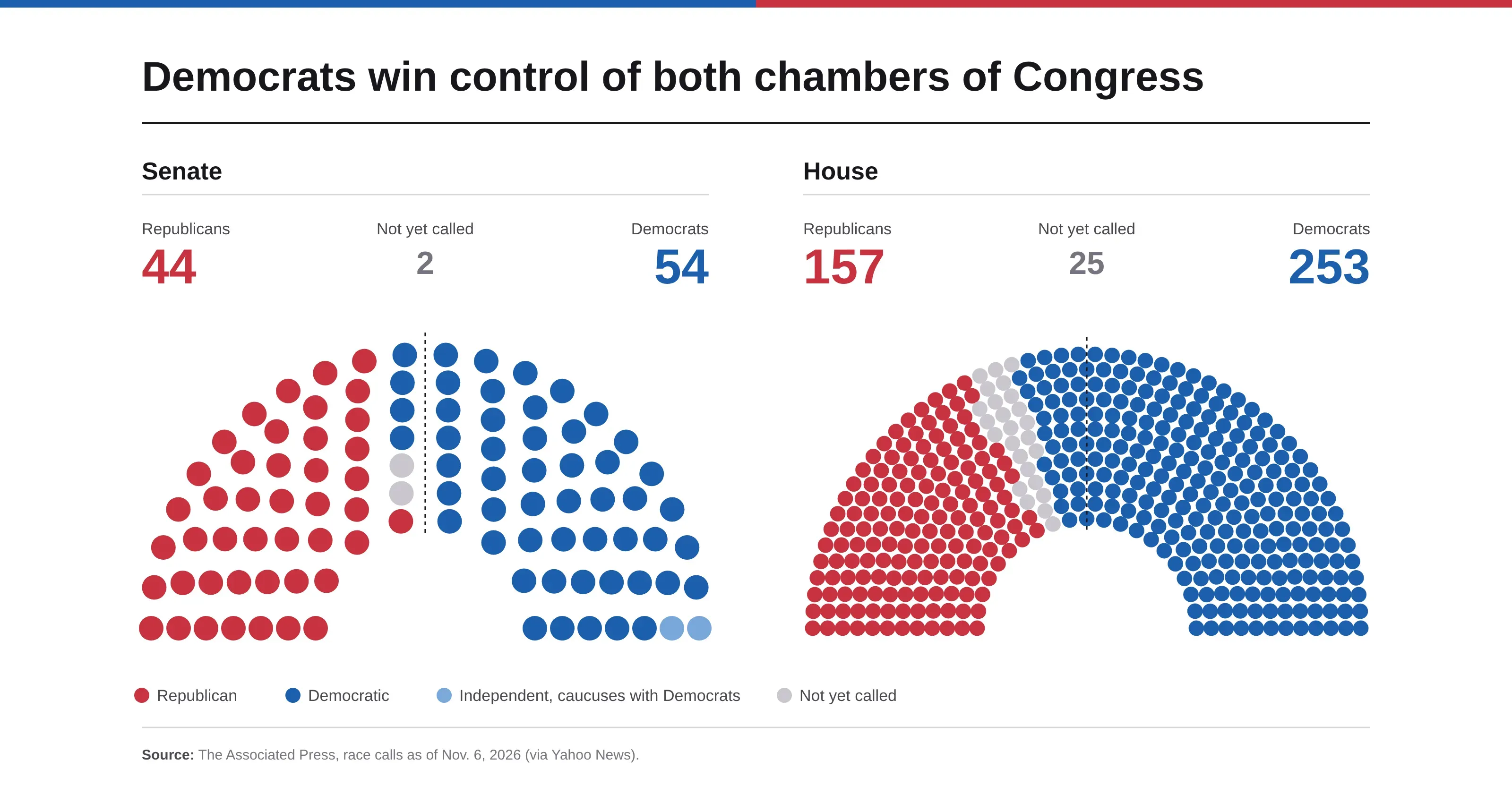
The balance of power in Washington is shifting. Based on Associated Press race calls as of Friday morning, Democrats will hold at least 54 Senate seats, including two independents who caucus with them, compared with 44 for Republicans. That clears the 51 seats needed for the majority. In the House, Democrats have won 253 seats to Republicans’ 157, past the 218 needed for control, with 25 races still being counted. According to CBS News, Democrats flipped seven Senate seats and dozens of House seats.

The final picture is not complete. In Mississippi, Democrat Scott Colom led Republican Sen. Cindy Hyde-Smith by about 1,800 votes with 96% counted. In Alaska, Democrat Mary Peltola led Republican Sen. Dan Sullivan by about 600 votes, and under state law the ranked-choice count can’t begin until 15 days after Election Day. When the new Congress is sworn in this January, the country will have a divided government with a Republican president and a Democratic Congress, illustrating a shift in how Americans are voting.

The Current