
Connect With Us
The Current

Our Insights

June 14, 2026

STORY OF THE WEEK

OpenAI Files for IPO, SpaceX Begins Trading

The race to go public heats up as AI giants and SpaceX chase historic valuations.

OpenAI Files for IPO, SpaceX Begins Trading

OpenAI confidentially filed IPO paperwork with the SEC, setting up a possible public debut as early as September. The company said timing remains undecided, citing tradeoffs tied to being public versus private. Goldman Sachs and Morgan Stanley are leading the offering, with a debut valuation expected to exceed $1 trillion. The filing follows a $122 billion fundraise from Amazon, Nvidia, and SoftBank, valuing the company at $852 billion and standing as the largest private technology financing ever completed.

Meanwhile, SpaceX began trading Friday on Nasdaq under SPCX in what stands as the largest IPO in history. Shares priced at $135, valuing the company near $1.77 trillion on a roughly $75 billion raise that dwarfs prior records set by Saudi Aramco and Alibaba. SpaceX's S-1 disclosed 2025 revenue of $18.7 billion, with Starlink generating $11.4 billion and reaching 10 million subscribers as of Q1 2026. The AI division posted a $6.4 billion operating loss in 2025. Market sentiment was further lifted by President Trump's comments suggesting an imminent peace agreement with Iran.

With two major AI IPOs in motion and SpaceX actively trading, investors are watching whether revenue growth can keep pace with the capital commitments driving current valuations.

  • Shares rocketed to $176 before settling up +19% as of the close.

  • OpenAI's filing follows a $122 billion fundraise from Amazon, Nvidia, and SoftBank, with analysts projecting a debut valuation above $1 trillion.

  • SpaceX's $75 billion raise surpasses the combined proceeds of all U.S. IPOs over the past two years.

CLIMBS OF THE WEEK

What's Up in the Markets

What's Up in the Markets

CAVA (+25.4%): A recent share price downturn and restaurant headwinds were put on the backburner as investors are optimistic about an end to the war.

STUB (+22.4%): Shares rallied as the World Cup games began Thursday in North America.

SG (+22.0%): Investors considered a low valuation an opportunity to capitalize on potential brand turnaround and restaurant rally surrounding optimism on gas prices.

SLIDES OF THE WEEK

What's Down in the Markets

What's Down in the Markets

ADBE (-18.7%): Shares fell to multi-year lows after Wall Street questioned whether Adobe's "freemium" AI push will delay near term monetization, with several analysts cutting price targets.

ORCL (-13.9%): Stock tumbled despite a positive earnings surprise, as investors balked at plans to raise $40 billion for AI data center spending and weaker margin guidance.

CRM (-10.6%): Shares trade near a 52-week low despite AI business growth topping 200%, as investors question whether overall growth justifies the valuation.

CHART OF THE WEEK

Workers' of Corporate Income Hits Record Low

Workers' of Corporate Income Hits Record Low

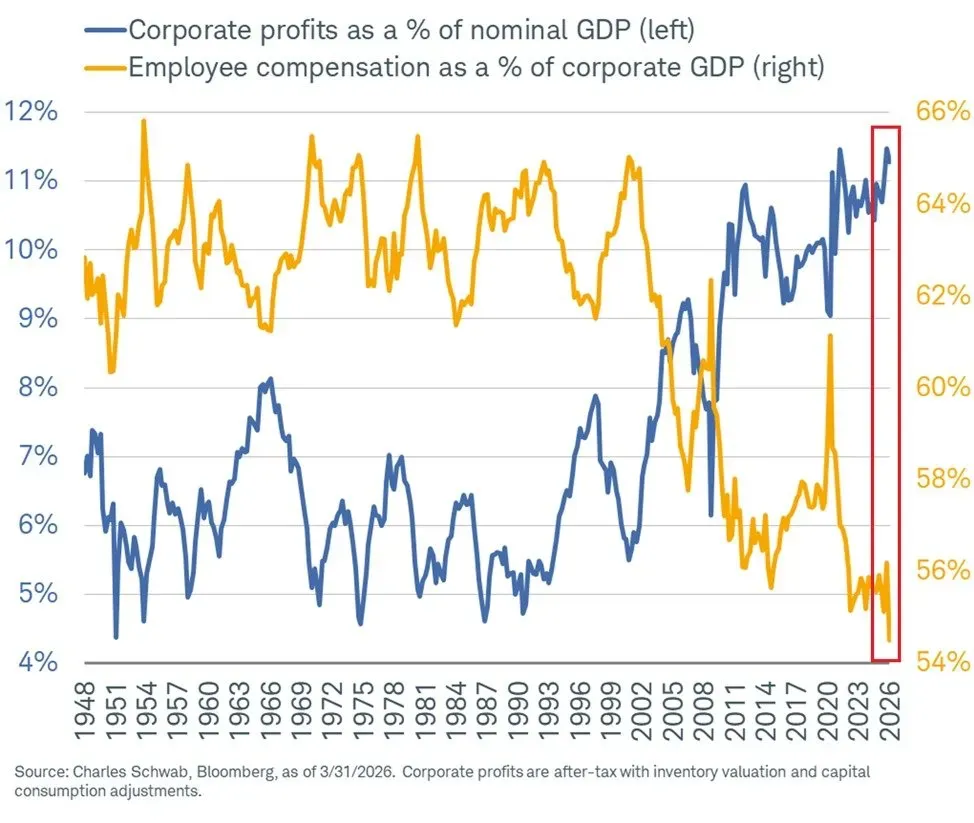
Employee compensation as a share of corporate GDP has fallen to roughly 54%, the lowest level since records began in 1948. For the first five decades, the labor share swung between roughly 62% and 66%, recovering with each expansion. That pattern broke around 2001, as globalization, automation, and offshoring turned a cyclical dip into a structural slide. The remaining 46% flows to profits, interest, taxes, depreciation, and other corporate income components.

Over the same period, corporate profits as a share of GDP have climbed to about 11.5%, an all-time high. The profit share spent most of the postwar era mean-reverting between roughly 4.5% and 8% before breaking higher. Since 2001, the labor share has dropped 10 points while the profit share has doubled. That shift helps explain two decades of corporate earnings outpacing the economy, and leaves workers with a smaller slice of the income they help generate than at any point on record.

The Current