
Connect With Us
The Current

Our Insights

August 9, 2026

STORY OF THE WEEK

Karp's AI Ownership Push Gains Real Traction

Palantir's blowout quarter adds fresh evidence to CEO Alex Karp's argument that enterprises and governments want to

Karp's AI Ownership Push Gains Real Traction

Palantir's blowout quarter adds fresh evidence to CEO Alex Karp's argument that enterprises and governments want to own their compute, models, and data rather than lease them from frontier labs.

Palantir CEO Dr. Alex Karp has spent the past month arguing, in a pair of CNBC interviews, that charging enterprises by the token is unsustainable, forcing companies to hand over data and intellectual property for systems that fail to solve their unique problems. He casts it as a national security issue, saying enterprise and government buyers alike want to own their compute, weights, and data outright.

Those arguments are shaping Palantir's roadmap, as the company deepens its partnership with Nvidia to build Nemotron models into its Sovereign AI platform, letting clients run AI on infrastructure they fully own instead of leasing it. The market has taken notice, with shares extending their climb after the interviews and again once quarterly results landed, a sign that investor appetite for alternatives to closed model providers is building well beyond this quarter's results.

  • U.S. commercial revenue rose +149% year-on-year, proving enterprises are demanding fine-tuned open weight models

  • Palantir is focused on the benchmarks that matter to their customer, instead of the benchmarks that AI labs base the “best model” judgement on

  • Karp publicly noted that Dario Amodei is “not the caricature people think he is” as Anthropic positions themselves as the ethical AI company

Karp's central case, that the next phase of enterprise AI will be defined by who owns the infrastructure and not who builds the smartest model, is no longer just a talking point. Palantir offers one data point, but the larger test is whether other enterprises and governments follow the same path.


CLIMBS OF THE WEEK

What's Up in the Markets

What's Up in the Markets

NET (+7.6%): Cloudflare shares jumped after the company illustrated accelerating Agentic AI demand and an optimistic roadmap.

NEM (+20.6%): Newmont surged after the gold mining company traded in step with a gold rally, related to an ease in Iran tensions.

ABNB (+17.5%): Airbnb shares rallied after the company proved resilient travel demand backed by World Cup bookings.

SLIDES OF THE WEEK

What's Down in the Markets

What's Down in the Markets

UA (-8.6%): Under Armour cut its full-year revenue outlook after posting weaker than expected sales, as softening demand in North America and Asia-Pacific weighed results.

SG (-16.3%): Sweetgreen shares fell as widespread consumer fear over a multistate cyclospora outbreak hit foot traffic, even though the chain isn't linked to the tainted produce.

SEZL (-23.7%): Despite beating on both revenue and earnings, Sezzle shares tumbled over 20% as investors reacted to management's forecast of slowing growth heading into the second half of the year.

CHART OF THE WEEK

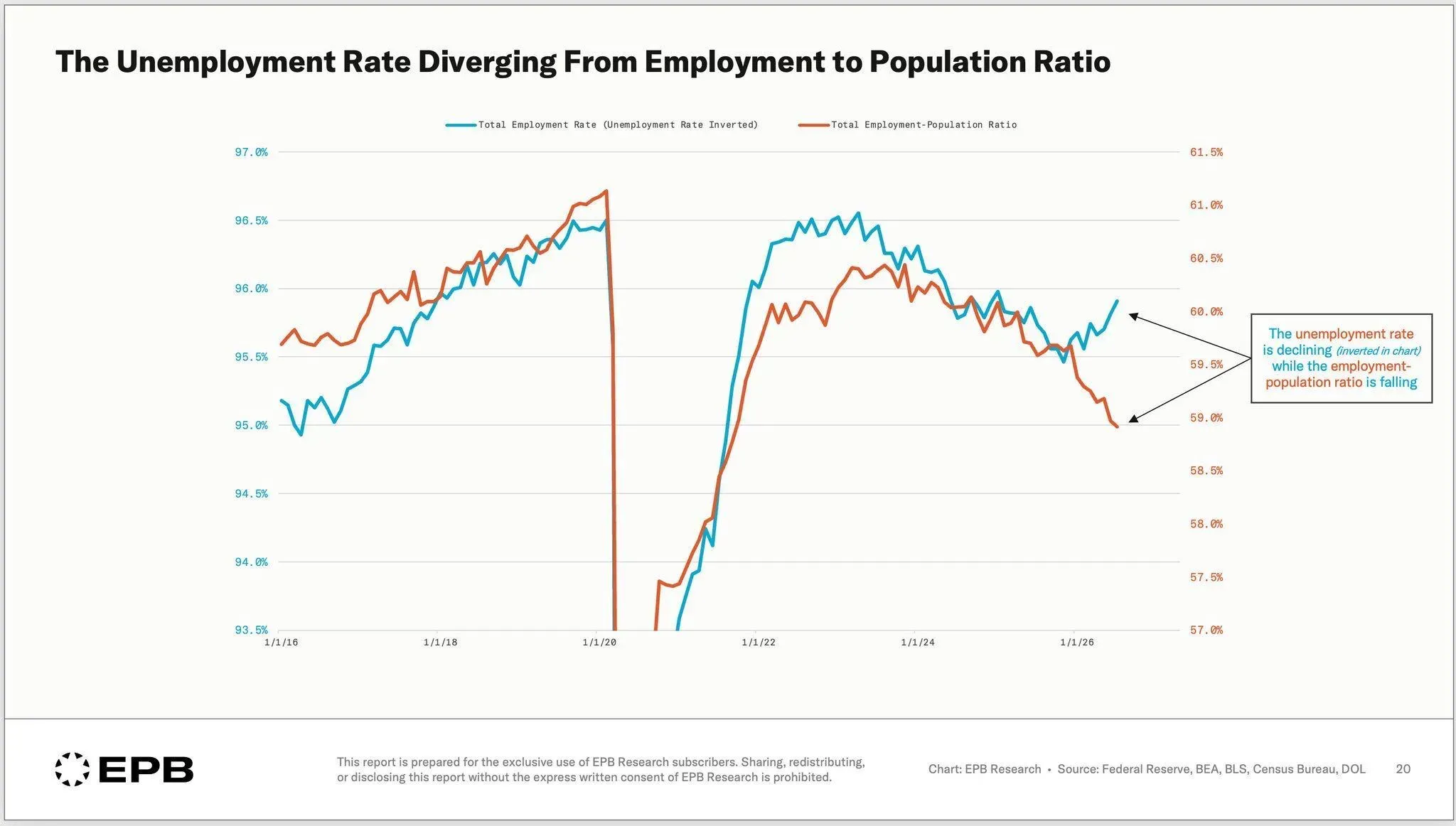
A Falling Unemployment Rate Isn't the Whole Story

A Falling Unemployment Rate Isn't the Whole Story

The unemployment rate has been improving even as a broader gauge of the labor market, the share of the entire population that is actually working, keeps drifting lower. That divergence is not a contradiction so much as a warning sign about what the unemployment rate leaves out. It only counts people who are actively searching for a job, so when discouraged workers stop looking and exit the labor force altogether, the rate can fall even without any real gain in hiring. The employment to population measure carries no such blind spot, since it is measured against the entire population rather than just those still counted as job seekers.

For investors and consumers alike, the takeaway is to look past the unemployment rate as a standalone signal. A falling rate driven by shrinking participation points to a softer economy than the headline suggests, with fewer people earning wages even if fewer are technically counted as unemployed. Watching the employment to population trend alongside the unemployment rate gives a clearer read on whether hiring is genuinely picking up or whether workers are simply stepping to the sidelines.

The Current