
Connect with Us
The Current

Our Insights

February 15, 2026

Japan Surges on Political Clarity While U.S. Tech Extends Its Slide

The most important global divergence this week came from opposite sides of the Pacific. In Japan, equities rallied sharply after Prime Minister Sanae Takaichi secured a decisive election victory

STORY OF THE WEEK

Japan Surges on Political Clarity While U.S. Tech Extends Its Slide

Takaichi’s victory lifted Nikkei while valuation anxiety weighed on Wall Street

Japan Surges on Political Clarity While U.S. Tech Extends Its Slide

The most important global divergence this week came from opposite sides of the Pacific. In Japan, equities rallied sharply after Prime Minister Sanae Takaichi secured a decisive election victory, reinforcing expectations for policy continuity and pro-growth fiscal support.

The Nikkei 225 pushed toward fresh highs as investors priced in stability, a weaker risk premium, and continued corporate reform momentum. Financials and exporters led gains, reflecting optimism around domestic demand and improved capital allocation.

In contrast, U.S. markets extended their pullback. The S&P 500 and Nasdaq Composite remained under pressure as selling in mega-cap technology persisted. Investors continued rotating away from high-multiple growth names amid concerns about AI monetization timelines, margin compression, and elevated capital spending. Earnings reports did little to reverse sentiment, with traders focusing more on forward guidance and cash flow durability than long-term innovation narratives.

By week’s end, the contrast was clear. Japan benefited from political clarity and improving confidence, while the U.S. faced valuation resets and sector rotation.

What’s the key takeaway?

  • Japan rallied on election certainty and policy continuity

  • U.S. tech extended its correction amid AI valuation concerns

  • Global markets showed widening regional divergence

The week underscored how stability attracts capital, while uncertainty reprices it quickly.

CLIMBS OF THE WEEK

What's Up in the Markets

What's Up in the Markets

RIVN (+19.8%): Rivian shares surged after the EV maker beat quarterly expectations and guided to sharply higher deliveries driven by its lower-cost R2 launch, boosting confidence in its path to scale despite ongoing losses.

GFS (+14.2%): GlobalFoundries shares jumped after strong revenue guidance and a $500 million buyback highlighted accelerating AI-driven demand, particularly in silicon photonics.

AMAT (+10.0%): Applied Materials shares jumped after earnings and guidance topped expectations, driven by strong AI-related demand for advanced chipmaking equipment.

SLIDES OF THE WEEK

What's Down in the Markets

What's Down in the Markets

HIMS (-29.2%): Hims & Hers shares dropped after the FDA flagged serious manufacturing violations tied to its compounded semaglutide, heightening regulatory and legal risks.

CBRE (-16.1%): CBRE shares slid as investors rotated out of AI-exposed, labor-intensive business models, even after the company delivered an earnings beat and strong guidance.

AJG (-13.7%): Arthur J. Gallagher shares dropped after news that an AI insurance app on ChatGPT could bypass traditional brokers, fueling disruption fears.

CHART OF THE WEEK

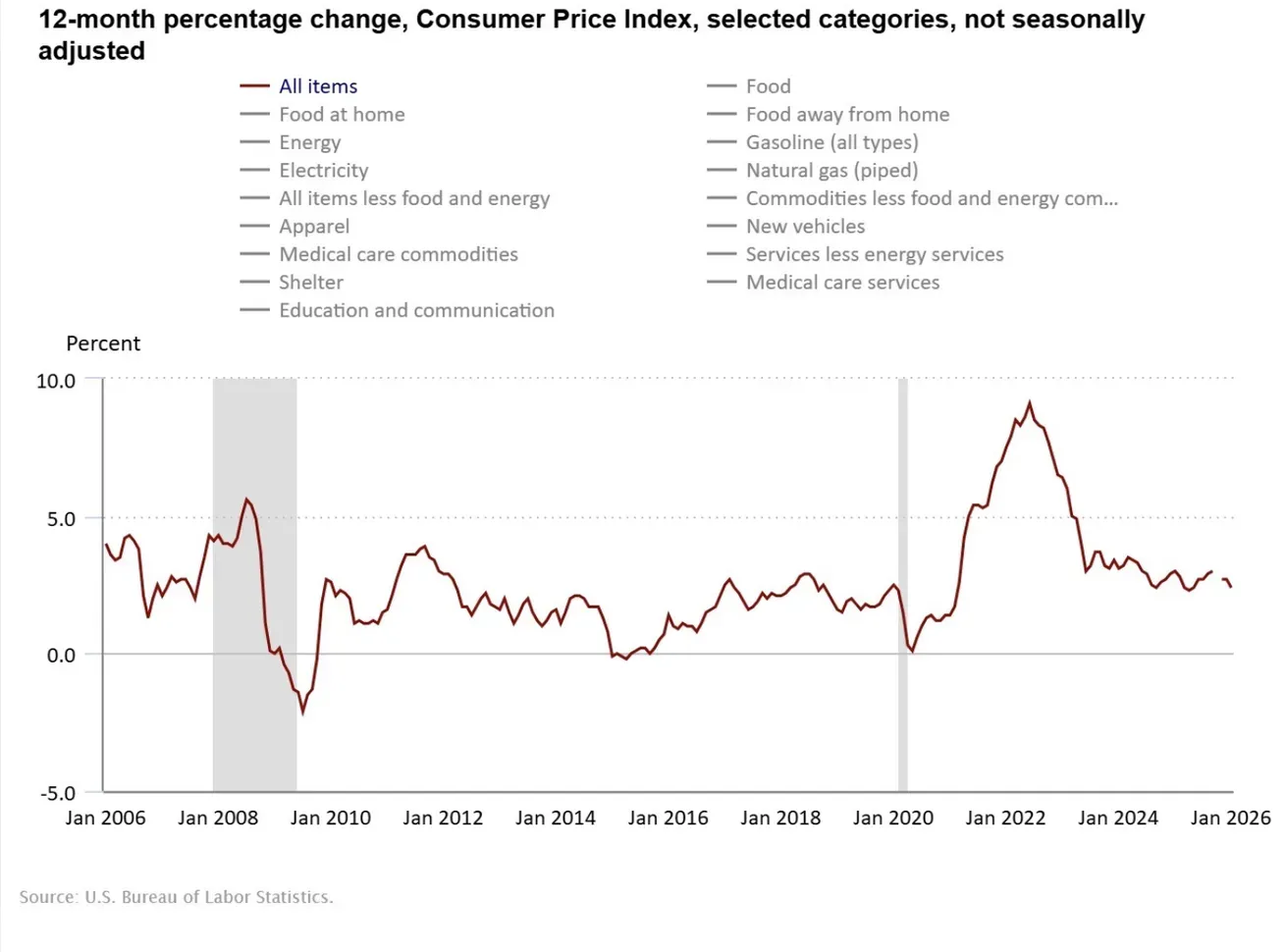
Inflation Cools More Than Expected, Easing Early-Year Fears

Inflation delivered a welcome downside surprise in January, with headline CPI rising just 0.2%

Inflation Cools More Than Expected, Easing Early-Year Fears

Inflation delivered a welcome downside surprise in January, with headline CPI rising just 0.2% month over month and 2.4% year over year, below expectations and down from December’s 2.7% pace. The softer print marked broad progress at the start of the year and helped calm concerns that seasonal price resets or tariff pass-through would reignite inflation pressures. Core CPI rose 0.3% in the month and 2.5% annually, matching forecasts and posting its slowest yearly increase since March 2021.

The data followed a stronger-than-expected jobs report earlier in the week, reinforcing the narrative of a resilient but gradually cooling economy. Energy prices declined, and used car prices fell, offsetting continued strength in select categories such as airfares and certain food items. Notably, core goods prices showed little evidence of renewed tariff-driven acceleration.

While pockets of price pressure remain, the report suggests inflation is moderating without derailing growth, supporting expectations that policy rates may remain steady as disinflation continues.

The Current