
Connect with Us
The Current

Our Insights

March 15, 2026

Governments Race to Contain the Hormuz Shock

**Governments Race to Contain the Hormuz Shock **

STORY OF THE WEEK

Governments Race to Contain the Hormuz Shock

From emergency reserve releases to pipeline pivots, policymakers scramble for damage control

Governments Race to Contain the Hormuz Shock

**Governments Race to Contain the Hormuz Shock **

The global policy response to the Hormuz closure intensified this week as governments and energy giants moved from monitoring to action. The 32 IEA member states unanimously agreed to release 400 million barrels from emergency reserves, the largest coordinated release in history. Despite the announcement, the IEA warned the outlook hinges entirely on whether commercial shipping can safely resume.

Aramco CEO Amin Nasser issued the industry's starkest warning yet, calling this "by far the biggest crisis the region's oil and gas industry has faced" and cautioning of catastrophic global consequences the longer the disruption persists. Aramco is rerouting crude through the East-West Pipeline toward Yanbu, though capacity falls far short of the 18M bpd that normally transits Hormuz. Saudi Arabia, UAE, Iraq, and Kuwait have all begun cutting output as export routes remain blocked.

Trump signaled the U.S. Navy could begin escorting tankers through the strait, while India floated a similar proposal. Japan's refiners formally requested government reserve releases, and South Korea flagged emergency contingency plans.

  • IEA's 400M barrel release is a buffer, not a fix: flows don't resume without physical security.

  • Pipeline diversions cover only a fraction of normal Hormuz volumes.

  • The Houthi wildcard remains: Red Sea rerouting is only viable if the Yemen truce holds.

The policy toolkit is being deployed in full, but every measure assumes a short conflict. A prolonged closure has no adequate response.

CLIMBS OF THE WEEK

What's Up in the Markets

What's Up in the Markets

HIMS (+57.4%): Hims & Hers is up after striking a deal with Novo Nordisk to offer branded GLP-1 medications, while discontinuing its compounded alternatives.

NBIS (+26.4%): Nebius shares rose after Nvidia's $2 billion investment validated Nebius as a core AI infrastructure platform. The company projects $3.0 to $3.4 billion in 2026 revenue at roughly 40% adjusted EBITDA margins.

MU (+15.1%): Micron shares rose after several analysts raised price targets on Micron ahead of its March 18 earnings report, with Wedbush, GF Securities, citing AI demand and tightening supply point to a memory upcycle that could extend well into 2027.

SLIDES OF THE WEEK

What's Down in the Markets

What's Down in the Markets

PSKY (-18.9%): Paramount Skydance faced pressure after Senator Warren criticized the Trump administration's CFIUS review of Paramount's $111 billion acquisition of Warner Bros. Discovery, citing national security concerns over $24 billion in funding from Middle Eastern sovereign wealth funds.

OWL (-11.5%): Blue Owl shares fell as redemption requests spiraled at the direct lender, adding to broader scrutiny across the roughly $2 trillion private credit market.

SYK** **(-6.0%): Stryker shares fell for a third straight session after an Iran-linked hacking group attacked its Microsoft-based systems, disrupting operations and leaving the financial impact yet to be determined.

CHART OF THE WEEK

Global Oil Prices Cross $100 as Middle East Crisis Escalates

**Global Oil Prices Cross $100 as Middle East Crisis Escalates **

Global Oil Prices Cross $100 as Middle East Crisis Escalates

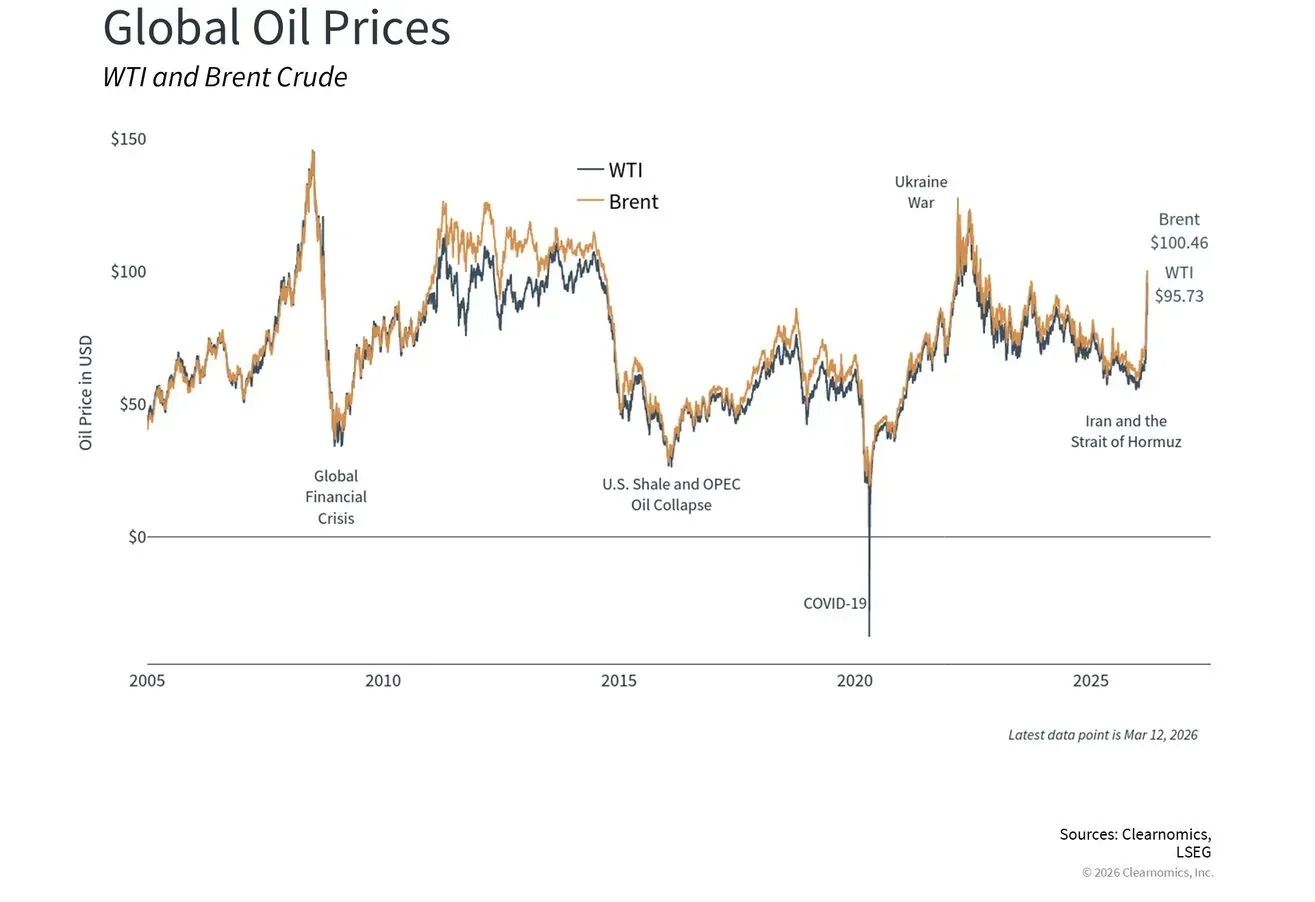
Over the past two decades, global oil prices have been shaped by a series of sharp shocks and recoveries. Brent and WTI peaked near $145 during the 2008 commodity boom before the Global Financial Crisis drove prices back toward $40. A second peak around $110 to $120 preceded the 2014 to 2016 collapse triggered by the U.S. shale boom and OPEC's price war. COVID-19 briefly sent WTI into negative territory in 2020 before a rapid recovery, and the 2022 Ukraine War pushed both benchmarks above $120.

After two years of gradual decline into the mid-$60s, the current Iran conflict and Strait of Hormuz disruption has driven another sharp reversal, with Brent now at $100.46 and WTI at $95.73, marking the most significant supply shock since the Ukraine War.

The Current