
Connect With Us
The Current

Our Insights

May 31, 2026

STORY OF THE WEEK

Dell Rides the AI Wave With Washington’s Help

An earnings beat, federal spending, and political attention converged to push Dell up nearly 40% in continuation of AI momentum.

Dell Rides the AI Wave With Washington’s Help

Dell Technologies surged nearly 40% after a week that combined strong earnings, accelerating AI demand, and support from Washington. The company reported one of its strongest quarters since returning to public markets, but the rally was not driven by earnings alone. Dell also benefited from a five-year, $9.7 billion Pentagon agreement and recent public praise from President Trump, who encouraged Americans to buy Dell computers days before the move.

Dell’s five-year Pentagon agreement, announced Wednesday, allows the company to supply Microsoft software and related services across the Department of Defense, the U.S. Coast Guard, and the intelligence community under a broad purchasing arrangement. For investors, the week highlighted how corporate performance, federal spending, and presidential attention can combine to amplify market reactions around companies tied to AI and national technology priorities.

  • Dell reported revenue of $43.8 billion, up 88% year over year for the quarter, and are projecting $167 billion in FY27.

  • AI server revenue reached $16.1 billion; the company raised its full-year AI server revenue forecast from $50 billion to $60 billion.

  • Dell secured a five-year, $9.7 billion Pentagon agreement tied to Microsoft software, cloud subscriptions, and federal technology services.

Dell’s results were strong on their own, but the week showed how quickly markets can react when strong earnings are paired with government contracts and political attention. Whether that attention becomes a lasting support for the stock remains unclear, but Dell’s week showed that investors are increasingly willing to price in more than the numbers alone.

CLIMBS OF THE WEEK

What's Up in the Markets

What's Up in the Markets

SNOW (+48.3%): AI-driven demand and a new $6 billion AWS partnership lifted the data-cloud company after strong earnings.

MU (+29.3%): UBS’ bullish outlook and Trump’s praise pushed the memory-chip maker above a $1 trillion market value.

BBY (+26.5%): Strong earnings and improving sales trends lifted the electronics retailer as demand strengthened for gaming, computers, and mobile phones.

SLIDES OF THE WEEK

What's Down in the Markets

What's Down in the Markets

ZS (-23.4%): A disappointing outlook blindsided investors and sent the cybersecurity stock to a record drop despite better-than-expected quarterly results.

GAP (-9.6%): Soft apparel demand pressured the retailer after weakness at Old Navy and Athleta pushed management to cut its sales outlook.

SNPS (-9.4%): Investors looked past solid earnings and raised guidance, focusing instead on slower core growth and Ansys deal concerns.

CHART OF THE WEEK

AI's Inflationary Arc

AI's Inflationary Arc

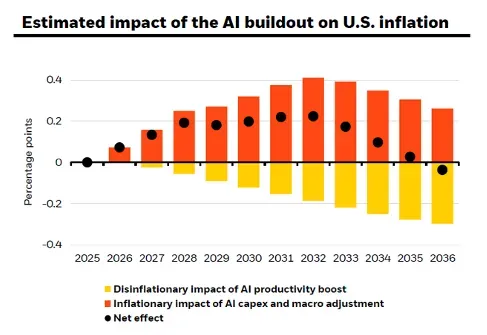
The near-term inflationary pressure from AI stems from several converging forces. Massive capital expenditure on data centers, chips, and energy infrastructure drives up input costs economy-wide. Simultaneously, labor market disruption plays a role: workers displaced faster than they can be reabsorbed create friction and sectoral cost pressures. Together, these push the net inflation impact to nearly 0.25 percentage points above baseline by the early 2030s before it begins fading.

The picture reverses meaningfully by mid-decade. As AI productivity gains compound across industries, supply-side efficiency improvements begin overwhelming the buildout costs. Displaced workers find new roles, many augmented by the same AI tools that disrupted them, adding to the productive capacity of the economy. By 2036, the net inflation impact turns slightly negative. The buildout phase carries real costs, but the long-run disinflationary dividend appears to make it a worthwhile trade.

The Current