
Connect with Us
The Current

Our Insights

May 10, 2026

Corporate America Posts Best Earnings Season in 20 Years

With roughly two-thirds of S&P 500 companies reporting, Q1 2026 has delivered what researchers are calling one of the strongest earnings seasons in two decades. For the first time in four years, all

STORY OF THE WEEK

Corporate America Posts Best Earnings Season in 20 Years

*84% of S&P 500 companies beat estimates in Q1 2026 — but the strength is not evenly distributed.*

Corporate America Posts Best Earnings Season in 20 Years

With roughly two-thirds of S&P 500 companies reporting, Q1 2026 has delivered what researchers are calling one of the strongest earnings seasons in two decades. For the first time in four years, all 11 sectors are on track to post simultaneous year-over-year earnings growth. Big banks set the tone early: JPMorgan's trading desk hit a record $11.6 billion quarter, while Citigroup posted its highest revenue in ten years.

The outperformance is concentrated in tech and financials. AI infrastructure spending drove double-digit growth at Amazon, Meta, Microsoft, and Alphabet, even as investors raise questions about overbuilding. Consumer-facing companies tell a different story. Gas prices running 50% above pre-war levels are weighing on discretionary spending, and Whirlpool warned of a "recession-level industry decline" with price increases ahead, which a sign the inflation transmission mechanism remains intact. Companies serving lower and middle income households have begun trimming Q2 outlooks.

  • AI is the engine: Amazon, Meta, Microsoft, and Alphabet all beat estimates on AI capital spending, while Palantir (PLTR) posted a record quarter with 84% revenue growth.

  • Fuel prices are the wildcard. McDonald's CEO flagged that pump prices are already affecting consumer behavior, with the impact expected to intensify through Q2.

  • Banks are booming, for now. Record trading activity powered strong quarters at JPMorgan, Citigroup, Wells Fargo, and Bank of America, though JPMorgan's Jamie Dimon renewed warnings about macro risk ahead.

The best earnings season in a generation is a genuine milestone, but with consumer sentiment weakening and energy costs rising, the second half of 2026 will test whether this strength is broad enough to last.

CLIMBS OF THE WEEK

What's Up in the Markets

What's Up in the Markets

IREN (+210.7%): The data center beneficiary signed a 5-year deal to provide cloud services to Nvidia.

PS (+33.7%): Bill Ackman’s latest IPO rose as investors hope a great earnings season flows through the fund’s investments.

RXT (+11.2%): Rallied this week after partnering with AMD in hopes ot provide an AI cloud platform for enterprises.

SLIDES OF THE WEEK

What's Down in the Markets

What's Down in the Markets

PLNT (-37.0%): A weak subscriber outlook overshadowed an otherwise healthy narrative from the company.

VITL (-29.8%): Robinhood’s crypto earnings spooked investors, missing expectations as crypto hype dies down.

BMBL (-13.0%): Despite strong results, investors in the company expected the future bar to be raised.

CHART OF THE WEEK

The Great Divide

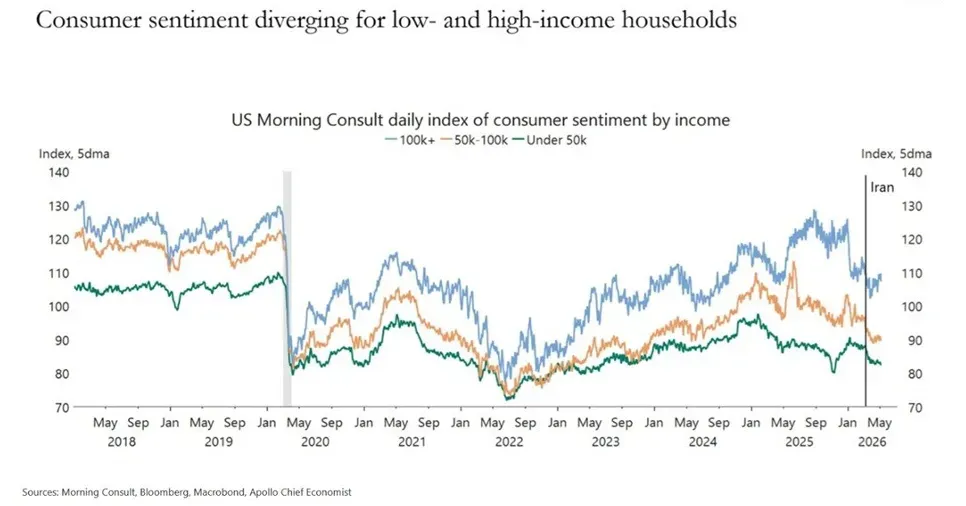
Gas prices up 60% year-to-date, now at $4.56 per gallon, are hitting lower-income households hardest

The Great Divide

Gas prices up 60% year-to-date, now at $4.56 per gallon, are hitting lower-income households hardest. Sentiment among consumers earning under $50,000 has fallen to roughly 82 points, matching pandemic-era lows and sitting near the lowest level since May 2023. The $50,000-$100,000 cohort is not far behind, with sentiment around 90 points after 14 consecutive months of decline.

High-income households are moving in the opposite direction. Consumers earning over $100,000 have seen sentiment climb back to roughly 110 points since February, above the 2023-2024 average. The divergence matters for the broader economy because lower- and middle-income households drive a disproportionate share of everyday consumer spending. As fuel costs continue to compress their budgets, the companies most exposed to that spending, restaurants, retailers, and home goods manufacturers, face a difficult second half.

The Current